Back
Tyre Particle Health, Environment & Safety - Research Report
Explainer Video
What are tyre particles and why do they matter?
TSA’s Head of Science & Research, Dr Linda Mitchell, shares insights into research on tyre and road wear particles.


Understanding tyre particles
TSA continues to engage in significant technical research programs aimed at more fully informing public debate and providing robust analysis of relevant issues and concerns.
A central focus of this work is understanding tyre particles. Everyday driving and road use, along with public infrastructure, generate and use different types of tyre particles. These particles vary in size and behaviour, and differ in how they interact with the environment.
TSA has reviewed more than 50 scientific and technical studies to provide a clear, evidence‑based overview of:
- How tyre particles form
- How they move through the environment
- What current science says about health and environmental impacts
- How recycled tyre products perform in real‑world applications
- Where more Australian research is needed

Click to enlarge
Image: Tyre and Road Wear Particles (TRWP).
What are the different types of tyre particles?
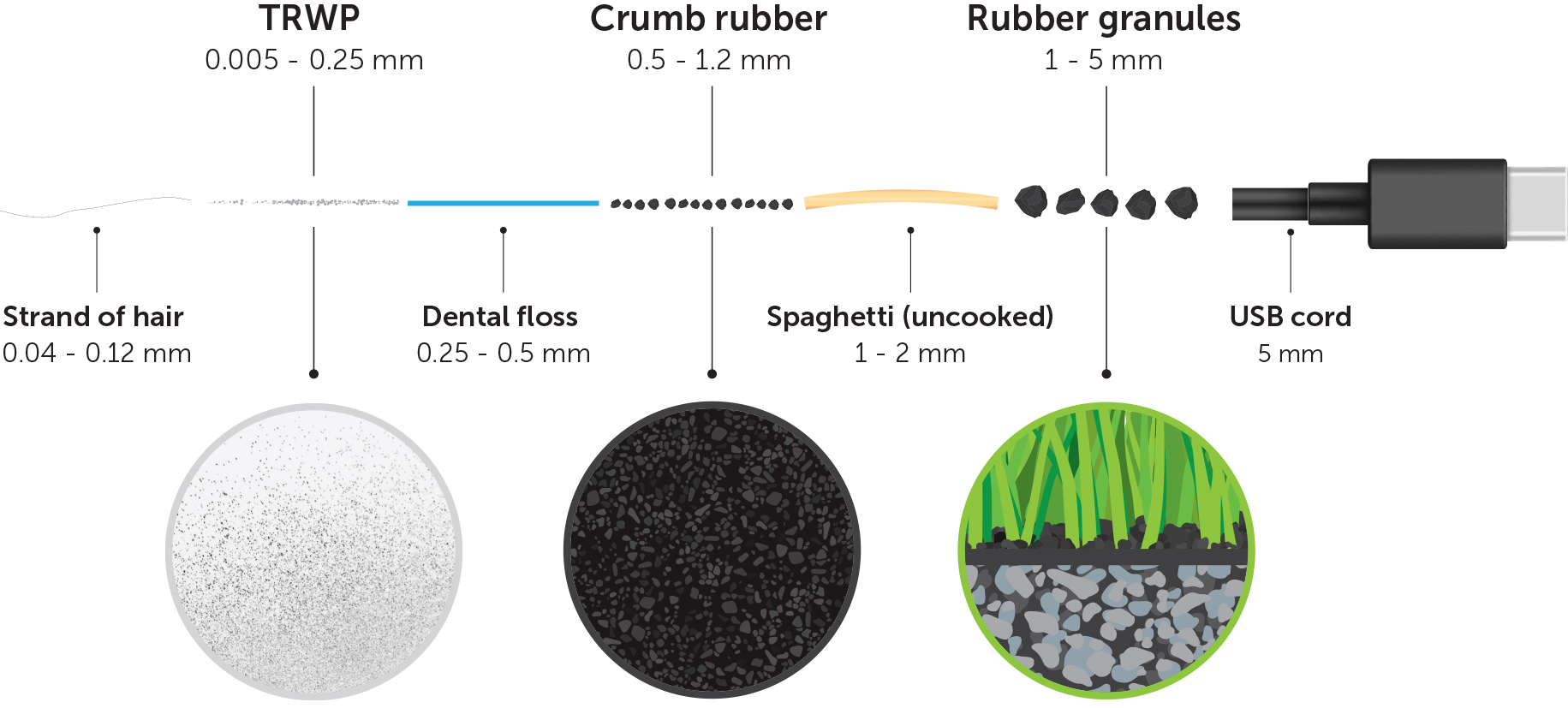
Tyre and Road Wear Particles (TRWPs)
Micro-sized particles produced during normal driving and transported through air and stormwater.
Rubber granules
Larger particles (~1–5 mm) used in recreational surfaces and pavements, contributing to cushioning and surface performance.
Crumb rubber
Fine particles (~0.5–1.2 mm) used in roads, improving durability and extending road life.
Click to enlarge
Image: Particle sizing chart.
What the research shows
Tyre and Road Wear Particles (TRWPs)
An assessment of international research studies into tyre and road wear particles (TRWPs) indicates a minor risk to human health and the environment at existing concentrations. Research continues into chemical pathways and concentrations, especially for particles transported through waterways.
Artificial turf with rubber infill
Artificial turf with rubber infill has been studied in great depth and the literature generally agrees there is a minor risk towards human health. Environmental impacts are generally low and further reduced with best practice management to minimise infill movement, with zinc highlighted as a substance to monitor over time.
Playgrounds and running tracks
Global research across a number of playground and running surfaces was assessed to have a minor risk towards the environment and human health. These surfaces also offer important benefits to safety.
Crumb rubber in roads
Crumb rubber enhances road durability. Emissions remain below SafeWork Australia standards, and the inclusion of crumb rubber does not appear to increase negative symptoms for asphalt construction workers.

Click to enlarge
Image: Examples of various actions and opportunities that exist to reduce tyre particle impacts during the entire lifecycle of materials.
Reducing impacts across the lifecycle
A range of practical measures can help reduce tyre‑particle impacts — from design and construction through to maintenance and end‑of‑life.
These include:
- Improved stormwater filtration and drainage
- Maintenance and containment measures on sports fields
- Good installation and storage practices
- Safe work practices for asphalt construction
- Improvements in tyre and road design
- Driving behaviour that reduces wear

Chemicals, Microplastics & Design: The Tyre Industry’s Global Shift
Growing concern around tyre chemicals is reshaping the industry worldwide. Governments, researchers and manufacturers are responding with new regulations, research and innovation—pushing tyres to become safer, more sustainable and lower impact.
What’s changing globally
- Stronger regulation: Focus on safety, emissions and environmental impact
- Smarter materials: Shift to sustainable rubber, recycled inputs and safer chemical alternatives
- Better performance: Reduced tyre wear to limit microplastics and particle emissions
Industry response
Tyre manufacturers are adapting fast—balancing sustainability goals with performance needs like safety and fuel efficiency. This is driving major changes in tyre design, from new materials and additives to redesigned treads and structures.
Innovation & research at scale
Global collaboration is accelerating progress:
- Industry groups and governments are tackling tyre emissions and end-of-life impacts
- New alternatives to harmful chemicals (like 6PPD) are under development
- Projects like BlackCycle are advancing circular solutions for used tyres
What this means for recycling
New materials and designs are opening up innovation—but also raising questions:
- Will current recycling methods keep up?
- Can end-markets handle more complex tyre compositions?
A whole-of-life approach is becoming critical to ensure new tyres can still be effectively recovered and reused.
The opportunity for Australia
Australia has a chance to align with global best practice while tailoring solutions locally. The challenge will be balancing regulation, industry competitiveness and environmental outcomes—while avoiding becoming a market for lower-standard tyres.
Read the full literature review — TSA x CSIRO
TSA collaborated with CSIRO on the Exploring Global Influences on the Tyre Industry: Chemicals of concern, microplastics and design literature review to shed light on how global regulations and innovations are shaping tyre design, chemical composition and efforts to reduce tyre wear.
Frequently Asked Questions
Check our FAQs below or contact us directly at getonboard@tyrestewardship.org.au if you have a question.

Stay up to date on the latest news and insights from TSA
Get in touch
Phone
Office
Office West, Suite 101, 271 Bridge Road,
Richmond VIC 3121
PO BOX 250 Richmond 3121