Back
Retread Tyre Resource Centre
Across Australia's heavy commercial fleets, retread tyres deliver lower cost per kilometer, longer asset life and proven emissions savings — yet they’re often overlooked in procurement decisions.
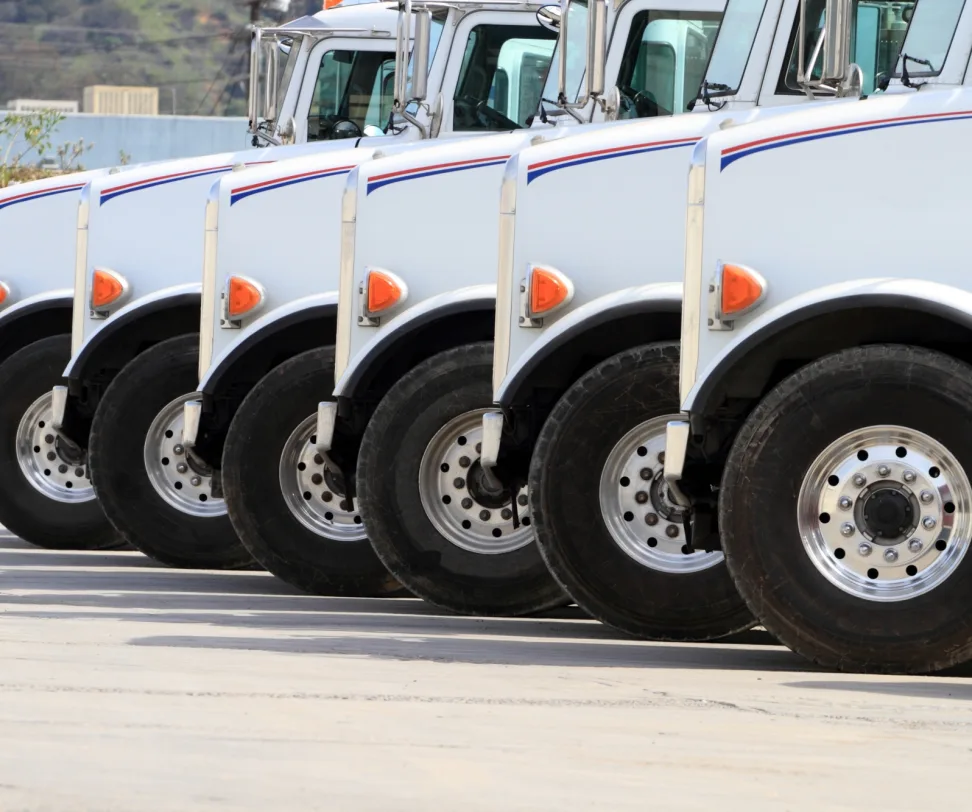
In heavy commercial fleets, every tyre purchase is really a long‑term decision about performance, reliability and cost.
This Resource Centre is designed to help people responsible for specifying, buying and managing truck tyres make those decisions with clarity. Drawing on Tyre Stewardship Australia’s Retread Tyre Sector in Australia: Comprehensive Market Analysis and practical industry insights, it sets out when retreads make sense — and why.
What is a retread tyre?
A retread tyre is produced by reusing a suitable tyre casing and applying new tread using controlled, industrial processes. The result is a like-new tyre that conserves most of the original tyre’s material and manufacturing energy compared to full replacement.
Not all tyres can or should be retreaded. The TSA report categorises heavy commercial tyres by quality:

Tier 1–2 tyres are designed for multiple retread lifecycles

Tier 3 tyres may be suitable for limited reuse

Tier 4–5 tyres are designed as single-use products and are not suitable for retreading
Why retreads — and why it matters
The casing of a heavy commercial tyre represents most of its material, energy and manufacturing value. Premium tyres are engineered to be used across multiple lifecycles, with retreading allowing that embedded value to be recovered rather than discarded.
Single‑use tyres may appear attractive at the point of purchase, but they are typically designed for one short lifecycle. Over time, this leads to higher replacement rates, greater downtime, increased disposal volumes and higher whole‑of‑life costs.
Retreads shift the focus from upfront price to asset life, performance consistency and cost per kilometre — which is how fleets actually experience tyre cost.

Retreads vs single‑use tyres
1. Cost‑per‑kilometre outcomes improve
Based on modelling in the TSA report, Tier 1 tyres used through retread lifecycles outperform single‑use tyres across all assessed heavy commercial segments when measured on cost per kilometre.
- Urban waste and bus applications see 29% lower cost per kilometre
- Short‑haul and regional construction applications see 31% lower cost per kilometre
- Long‑haul interstate freight sees 23% lower cost per kilometre
2. Tyre life is materially longer
The report finds single‑use tyres can deliver only 33–50% of the service life of Tier 1 tyres in demanding applications. In contrast, premium casings are designed to deliver multiple lives through retreading when properly maintained.
Independent testing shows that operators may need up to 3 times more single‑use tyres to travel the same distance as one premium tyre taken through retread lifecycles. (Source: Kal Tire)
3. Fuel efficiency is influenced by tyre quality
Rolling resistance is strongly affected by casing construction. The TSA report cites industry testing showing around 5% fuel efficiency improvements associated with higher-quality casings compared to single-use tyres in high-kilometre applications.
Retreads applied to premium casings can achieve rolling resistance performance comparable to new Tier 1 tyres, supporting lower fuel use and operating effort.
Quality comparison in action


How modern retreading works
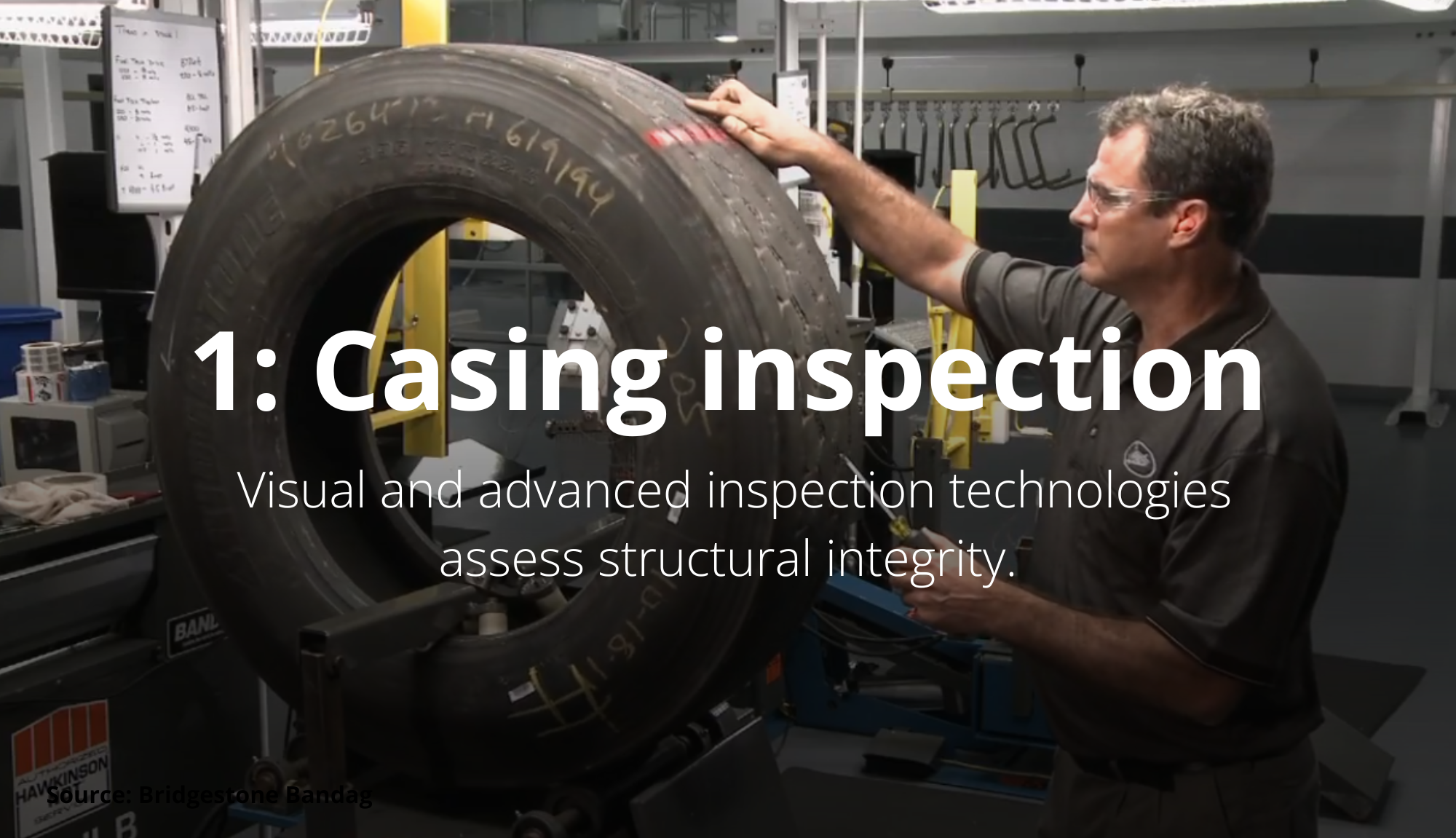
Modern retreading is a tightly controlled industrial process governed by national standards and quality assurance systems. In Australia, retread facilities meet or exceed the requirements of AS 1973‑1993 for retreading and repair processes.

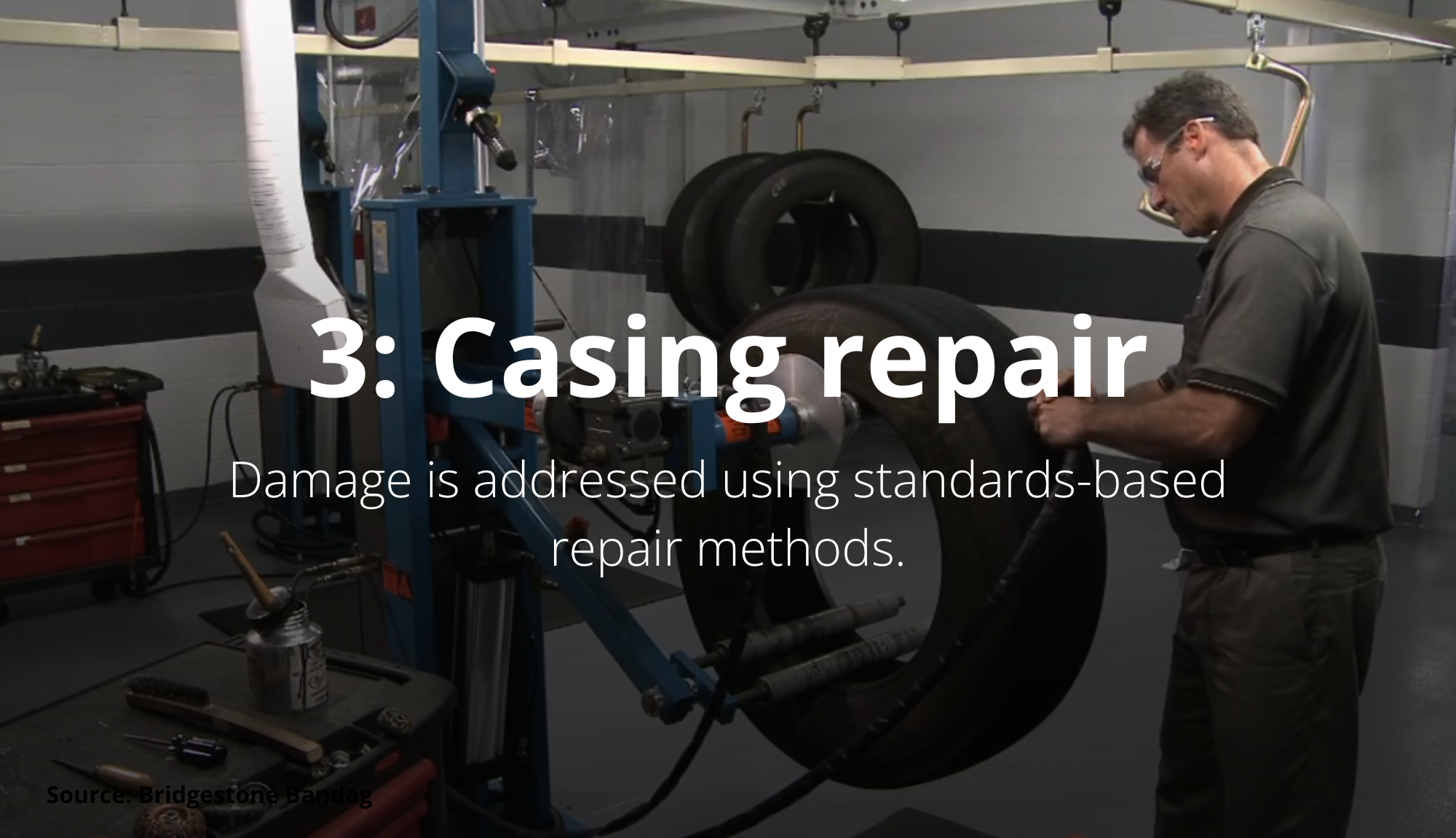


Watch the retreading process
Specify tyres as lifecycle assets — not consumables.
In heavy commercial applications, tyre value is realised over time through service life, durability, fuel efficiency and retreadability. Procurement approaches focused solely on unit price risk favouring single-use tyres that deliver poorer whole-of-life outcomes.
Best practice procurement frameworks:
- prioritise retread designed casings
- evaluate cost per kilometre, not purchase price
- recognise retreading as a legitimate remanufacturing process
Where retreads deliver the strongest value
The TSA analysis shows particular advantages in:
- Start-stop, high-scrub applications such as urban waste and public transport
- Regional and construction operations where tyre wear is accelerated
- Long-haul freight, where rolling resistance, fuel efficiency and breakdown risk materially affect costs
Retreads remain viable across all segments when matched to the right casing, tread pattern and maintenance regime.

When retreads are appropriate
Retread tyres are suitable wherever:
- vehicles operate in repeatable duty cycles
- tyre wear is predictable or accelerated
- downtime and changeovers impose operational cost
- high-quality casings can be maintained

Technical resources: industry perspectives
The following organisations provide detailed technical information on retreading systems and tyre lifecycle management. Links are provided for reference.
Michelin — Retreading services (truck and bus)
Michelin frames retreading as a deliberate lifecycle strategy rather than a downstream recycling option. Its retreading approach places strong emphasis on casing management, recognising the casing as the primary asset that determines performance, fuel efficiency and retread viability over time.
Key features highlighted by Michelin include:
- controlled inspection and selection of casings prior to retreading
- alignment between original tyre design and subsequent retread use
- tread options selected to suit specific operating applications rather than general use
Michelin’s material consistently links retreading to total cost of ownership, arguing that tyres designed for multiple lives perform more predictably across fleets and help stabilise cost per kilometre outcomes when managed as a system rather than as individual purchases.
Kal Tire — Retreads and repairs (mining and off‑road environments)
Kal Tire’s retread and repair programs are developed for high‑severity operating conditions, including mining and off‑road applications where tyre wear, damage and downtime carry significant cost and safety implications.
Kal Tire emphasises:
- retreading and repair as tools to keep tyres in productive service longer, even after damage
- quantitative comparison of retreads versus new tyres in terms of manufacturing emissions and operating cost per hour (reported on their site as approximately 70% lower manufacturing emissions and 31% lower cost per hour in mining contexts)
- quality assurance processes and third‑party accreditation to manage performance risk in critical applications
Unlike many fleet‑oriented retread discussions, Kal Tire explicitly integrates repair, retreading and reporting into a single lifecycle approach, illustrating how retreads operate as part of a broader asset‑management system rather than a standalone product choice.
Bridgestone / Bandag — Retread tyres
Bridgestone presents retreading through Bandag as a manufacturing and specification discipline, not simply a reuse activity. The Bandag system is based on reusing suitable truck and bus tyre casings and applying new pre‑cured tread using a standardised process, with a strong focus on consistency and application suitability.
From a technical and procurement perspective, the Bandag material focuses on:
- matching tread design to operating conditions (e.g. urban, regional, long‑haul)
- extending usable casing life to reduce the number of tyre replacements required
- assessing tyres on cost per kilometre, rather than upfront purchase price
Bridgestone positions retreading as a way to achieve predictable performance and lifecycle efficiency across fleets, particularly where tyre wear patterns are well understood and casings are properly maintained.
What good practice looks like for fleets and procurement
Encouraging retread uptake is not about mandating a single tyre choice — it is about:
- Prioritising retread-designed casings
- Measuring tyres on cost per kilometre, not unit price
- Matching tread design to operating conditions
- Maintaining inflation and inspection regimes that protect casings
This approach discourages low-quality, single-use tyres by design, without restricting operational flexibility.
The Retreadcast
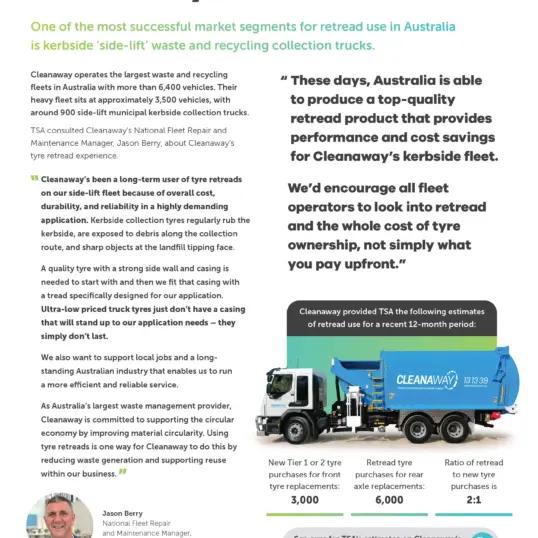
Episode #51 | Breaking Down Tyre Stewardship Australia’s Retreading Report


Stay up to date on the latest news and insights from TSA
Get in touch
Phone
Office
Office West, Suite 101, 271 Bridge Road,
Richmond VIC 3121
PO BOX 250 Richmond 3121