Mining & Agriculture

Who we work with
Mining and Agriculture
Off-The-Road (OTR) tyre users, such as the Mining and Agriculture industries, can tip the balance towards a truly national circular tyre economy.
OTR tyres and rubber products are built to last in tough conditions and are therefore a source of high-quality material for reuse in manufacturing and construction, particularly infrastructure such as roads.
Up to 245,000 tonnes of OTR rubber products are used and become waste each year, with around 80% of this coming from the mining sector and 10% from agriculture (with the remaining 10% of waste generation coming from Aviation, Construction and Industrial sectors).
Most of the OTR rubber products reach their end of life in regional, rural and remote areas of Australia. And regrettably, the vast majority of these used OTR products is buried on site, stockpiled, or sent to landfill. Currently just under 10% of used OTR tyres are recovered, compared to around 90% of automotive tyres.
Finding a new life for the valuable resources in used tyres offers many environmental, social, and economic benefits, particularly in regional, rural and remote Australia. But there are barriers to recovery, such as:
the low perceived costs of on-site disposal
the high costs of logistics and recovery
uncertainty about technologies and waste management approaches
uncertainty about end market size and capacity
a low priority for tyre waste stewardship.
Through TSA, mining and agricultural operators can overcome these barriers and find viable solutions to recover OTR tyres that have reached their end of life on site. See these case studies on what mining and recycling companies are already doing in Australia.
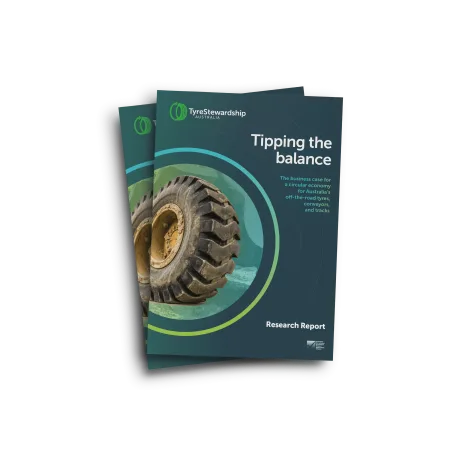
Research Report
Tipping the Balance
Based on significant research, data collection, stakeholder engagement, and consultation, in 2024, TSA delivered a comprehensive report called Tipping the Balance which outlined solutions for improving OTR rubber product recovery in Australia, such as:
- developing supply chain partnerships between all parties involved in supplying, using and recycling OTR rubber products – such as tyre recyclers, manufacturers, local businesses and government - in key catchment areas in every State, from the Pilbara in WA to the Bowen Basin in QLD
- using reverse logistics to expand delivery of new rubber products, by the tyre seller, to include collection of used products
- consolidation at a recovery centre local to a number of sites,
Tools and Resources
For Mining and Agriculture
Services
For Mining and Agriculture

Stay up to date on the latest news and insights from TSA
Get in touch
Phone
Office
Office West, Suite 101, 271 Bridge Road,
Richmond VIC 3121
PO BOX 250 Richmond 3121